The textile industry demands precision, durability, and consistency at every stage of production. From spinning to finishing, rollers play a crucial role in ensuring smooth material flow and maintaining fabric quality.
This is where polyurethane rollers in textile industry have emerged as a superior alternative to conventional materials. Known for their strength, flexibility, and resistance to harsh operating conditions, polyurethane rollers are now widely adopted across modern textile manufacturing units.
Manufacturers like Mecalsys are driving this shift by offering engineered roller solutions designed specifically for textile applications.
Table of Contents
What Are Polyurethane Rollers?
Polyurethane rollers are industrial rollers coated with high-performance polyurethane elastomers. These materials combine elasticity with toughness, allowing the rollers to withstand continuous mechanical stress without compromising performance.
In textile operations, these rollers are used for:
- Controlled fabric movement
- Uniform pressure application
- Chemical processing and finishing
- High-speed machine operations
Their ability to maintain structural integrity under demanding conditions makes them essential for modern textile processes.
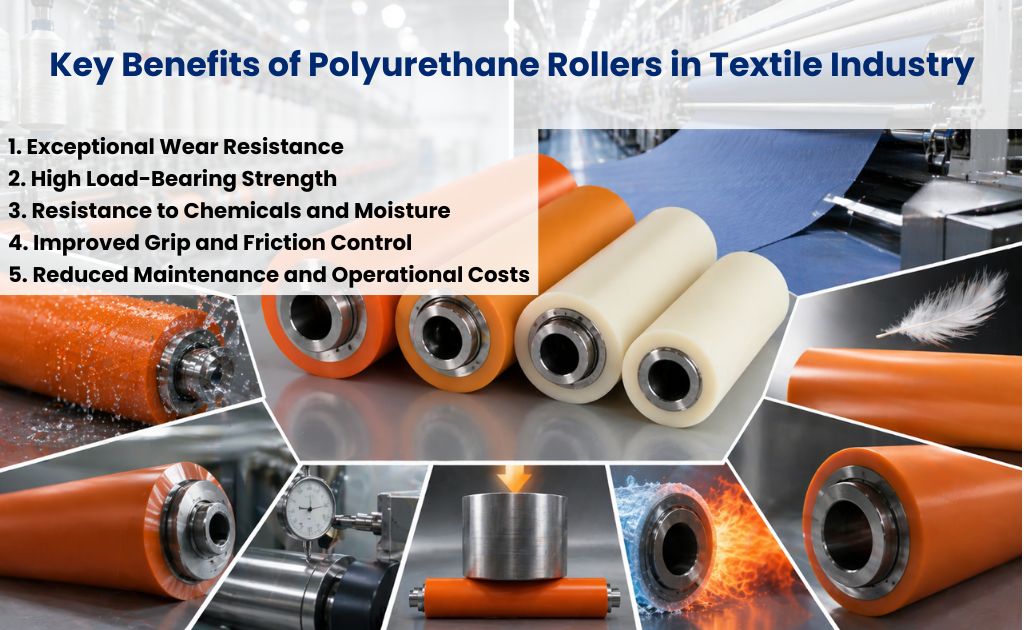
Key Benefits of Polyurethane Rollers in Textile Industry
1. Exceptional Wear Resistance
Polyurethane rollers are highly resistant to abrasion, cuts, and surface damage. Unlike rubber, they do not degrade quickly under continuous usage.
Impact: Longer service life and reduced downtime.
2. High Load-Bearing Strength
Textile machines often operate under constant pressure. Polyurethane rollers retain their shape and performance even under heavy loads.
Impact: Consistent output quality across long production cycles.
3. Resistance to Chemicals and Moisture
Textile processing involves exposure to dyes, chemicals, and water. Polyurethane materials resist swelling, corrosion, and degradation.
Impact: Reliable performance in dyeing and wet processing environments.
4. Improved Grip and Friction Control
These rollers provide uniform traction, ensuring smooth fabric movement without slippage.
Impact: Better fabric finish and reduced material wastage.
5. Reduced Maintenance and Operational Costs
Due to their durability and resistance properties, polyurethane rollers require less frequent replacement and minimal maintenance.
Impact: Lower long-term operational costs.
Applications of Polyurethane Rollers in Textile Industry
Spinning Operations
- Fiber handling systems
- Drafting processes
Weaving Units
- Warp control
- Tension regulation
Dyeing and Finishing
- Padding mangles
- Squeezing rollers
Processing and Coating
- Uniform chemical application
- Smooth fabric transport
These applications highlight the versatility of polyurethane rollers across the textile production chain.
Polyurethane Rollers vs Rubber Rollers
| Feature | Polyurethane Rollers | Rubber Rollers |
| Durability | High | Moderate |
| Abrasion Resistance | Excellent | Limited |
| Chemical Resistance | Strong | Weak |
| Lifespan | Long | Shorter |
| Maintenance | Low | High |
Polyurethane rollers provide a clear advantage in terms of performance, longevity, and cost efficiency.
Why Choose Mecalsys for Polyurethane Rollers?
Selecting the right manufacturer is as important as choosing the right material. The performance of a roller depends on engineering precision, material quality, and customization.
Mecalsys offers:
- Custom-designed polyurethane rollers for textile applications
- Precision-controlled hardness and surface finish
- High-quality material formulations
- Consistent manufacturing standards
- Reliable support for industrial-scale requirements
With a focus on performance and durability, Mecalsys delivers solutions that align with modern textile industry needs.
How to Choose the Right Polyurethane Rollers
To achieve optimal results, consider:
- Hardness (Shore A rating): Based on application requirements
- Load conditions: Machine pressure and speed
- Chemical exposure: Type of processing environment
- Surface finish: Required grip and smoothness
Choosing the correct specifications ensures maximum efficiency and longevity.
Future of Polyurethane Rollers in Textile Manufacturing
As textile production becomes more advanced and quality-driven, the demand for reliable and high-performance components continues to grow. Polyurethane rollers are expected to become the industry standard due to their ability to deliver consistent results under challenging conditions.
Conclusion
The adoption of polyurethane rollers in textile industry is driven by their superior durability, performance, and cost-effectiveness. Compared to traditional materials, they offer better resistance, longer lifespan, and improved operational efficiency.
For manufacturers aiming to enhance productivity and maintain consistent quality, investing in high-quality polyurethane rollers is a strategic decision-especially when sourced from experienced providers like Mecalsys.