Steel plants operate in some of the harshest industrial environments. Constant abrasion, high loads, vibration, chemical exposure, heat, and continuous material handling place enormous stress on rollers, pads, liners, and support systems. When these components fail, the result is costly downtime, damaged steel surfaces, frequent maintenance, and reduced production efficiency.
This is exactly why polyurethane components in steel plants have become a preferred solution across modern steel manufacturing facilities. Compared to conventional rubber, metal, and standard polymer parts, polyurethane offers exceptional wear resistance, better elasticity, superior impact absorption, and longer service life. It protects critical equipment while maintaining smooth and consistent plant operations.
From cold rolling mills and galvanizing lines to coil handling systems and metal forming operations, polyurethane plays a major role in improving productivity. Common applications include PU rollers, cradle rollers, polyurethane pads, wear liners, seals, and coated steel parts that require high durability under demanding conditions.
For industries looking for reliable and custom-engineered solutions, Mecalsys stands out as a trusted Chennai-based manufacturer specializing in high-performance polyurethane products for steel mills. Their expertise in custom polyurethane rollers, cradle rollers, pads, and steel-backed PU components helps steel plants reduce downtime and maximize operational life.
If your goal is better performance, fewer shutdowns, and lower replacement costs, Mecalsys delivers polyurethane components designed specifically for steel industry demands.
Table of Contents
The Role of Polyurethane in Steel Plants and Key Properties of Polyurethane
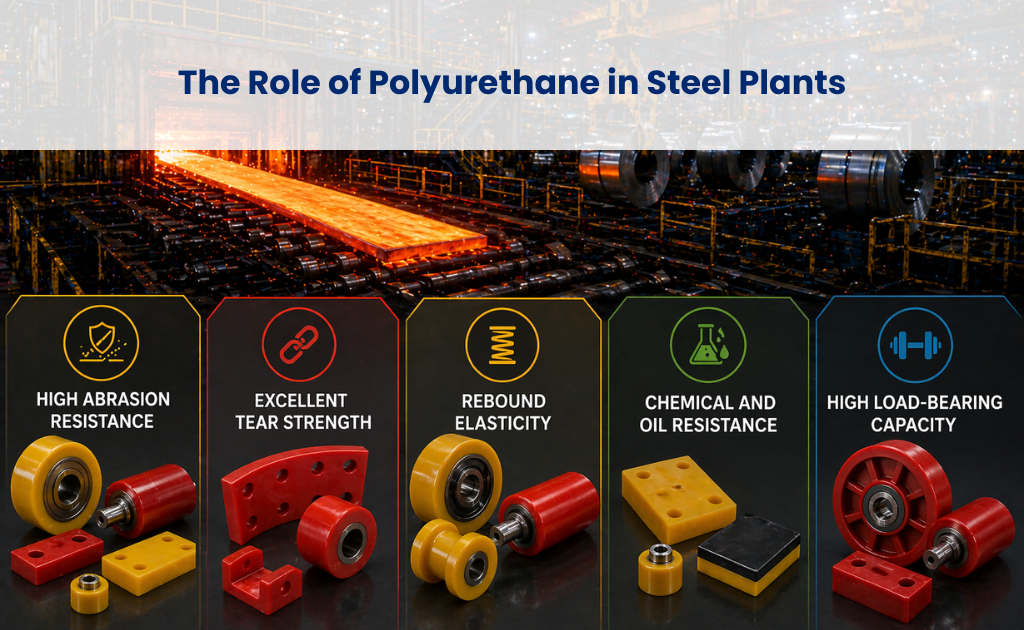
The demand for polyurethane components in steel plants continues to grow because steel production environments require materials that can survive extreme operating conditions without compromising performance.
Polyurethane combines the flexibility of rubber with the strength and toughness of engineered plastics. This unique balance makes it ideal for high-load industrial applications where wear resistance is critical.
High Abrasion Resistance
Steel processing creates constant friction between moving materials and machine parts. Polyurethane resists wear far better than standard rubber, making it ideal for steel mill rollers and wear surfaces.
Excellent Tear Strength
In high-tension areas like rolling mills and winding systems, polyurethane maintains structural integrity under pressure without tearing or deforming easily.
Rebound Elasticity
Polyurethane absorbs shock and vibration while maintaining shape recovery. This helps protect steel coils from dents, scratches, and handling damage.
Chemical and Oil Resistance
Steel plants often involve exposure to oils, coolants, solvents, and industrial chemicals. Polyurethane performs reliably in these conditions, making it ideal for protective liners and seals.
High Load-Bearing Capacity
For coil handling and metal forming, high-load polyurethane elastomers provide stability and performance even under extreme pressure.
Where Polyurethane Is Used
Typical applications include:
- Cold rolling mills
- Galvanizing lines
- Color coating lines
- Coil handling systems
- Winding and unwinding stations
- Leveling and tension control systems
- Metal forming and press operations
These polyurethane wear parts in rolling mills help reduce friction damage, improve surface quality, and minimize product rejection caused by scratches or impact marks.
At Mecalsys, each PU grade is selected based on the exact operating condition-ensuring the right balance of hardness, elasticity, and chemical resistance for every steel plant application.
Key Polyurethane Components for Steel Mills
Choosing the right polyurethane components in steel plants directly affects uptime, maintenance costs, and equipment life. Below are the most important components used across steel processing operations.
1. PU Rollers (Guide, Pinch, Tension Rollers)
PU rollers are among the most critical steel plant rollers used in rolling mills and finishing lines. They guide steel coils, maintain tension, and support continuous production flow.
Applications include:
- Coil guiding
- Tension control
- Pinch operations
- Drying lines
- Surface finishing systems
Mecalsys manufactures custom PU rollers with hardness ranging from 70 to 95 Shore A, designed for heavy-duty use with steel bonding for maximum durability.
2. Cradle Rollers
Cradle rollers are used for coil storage and transportation. Their purpose is to support steel coils without damaging the surface.
Poor-quality rollers can create scratches, dents, and deformation. Mecalsys cradle rollers feature high-impact absorption and non-marking surfaces that protect finished steel products during handling.
This makes them essential in cradle rollers steel processing operations.
3. Polyurethane Pads and Saddles
In press shops and coil support systems, polyurethane pads metal forming applications require strong rebound and pressure distribution.
These components:
- Prevent direct metal-to-metal contact
- Reduce tooling damage
- Improve pressure transfer
- Protect stored steel coils
Compared to rubber, polyurethane pads often deliver up to 3x longer service life.
4. Wear Liners and Seals
Abrasion-prone zones like conveyors, chutes, and handling systems require highly durable liners and seals.
These chemical-resistant PU liners protect equipment from:
- Friction wear
- Oil contamination
- Coolant exposure
- Chemical corrosion
This improves maintenance intervals and extends machine life.
5. Coated Mill Rollers
Steel-backed polyurethane-coated rollers are used in finishing and surface-sensitive applications.
These coated rollers offer:
- Precision contact
- Surface protection
- Reduced vibration
- Lower maintenance frequency
Mecalsys uses precision molding and advanced bonding techniques to ensure maximum reliability.
| Component | Steel Plant Use | Mecalsys Advantage |
| PU Rollers | Coil guiding, tension control | Custom hardness + steel bonding |
| Cradle Rollers | Coil storage and transport | Non-scratch surfaces |
| PU Pads/Saddles | Press forming, coil support | Superior rebound + long life |
| Wear Liners/Seals | Abrasion-prone zones | Chemical-resistant formulations |
| Coated Mill Rollers | Surface finishing lines | Precision molding |
These custom polyurethane components are engineered for long-term performance in demanding steel environments.
Benefits of Mecalsys Polyurethane Over Alternatives
When comparing polyurethane vs rubber in steel plants, the difference in performance is significant.
Polyurethane vs Rubber
Rubber is flexible but wears quickly in high-abrasion environments. It also performs poorly under continuous heavy loads.
Polyurethane offers:
- 5-10x longer service life
- Better tear resistance
- Higher load capacity
- Improved dimensional stability
This means fewer replacements and lower maintenance costs.
Polyurethane vs Metal
Metal parts are strong but create noise, vibration, and surface damage. They also lack shock absorption.
Polyurethane reduces:
- Surface scratches
- Equipment vibration
- Noise levels
- Impact damage
This improves both machine protection and workplace conditions.
Polyurethane vs UHMW
UHMW works for light-duty wear applications but lacks the load-bearing performance needed in rolling mills.
For industrial polyurethane for rolling mills, PU provides far better resilience under high-load continuous production.
The Mecalsys Advantage
Mecalsys offers:
- In-house PU formulation
- Precision custom molding
- Rapid prototyping
- Chennai-based manufacturing for fast delivery across India
- Steel-backed PU hybrid solutions
- Application-specific engineering support
Many clients report:
- Up to 40% reduction in downtime
- Improved roller life
- Lower maintenance costs
- Better product finish quality
This makes Mecalsys a leading supplier of abrasion-resistant polyurethane for the steel industry.
Problems Faced by Steel Plants Without Good Quality Polyurethane Components
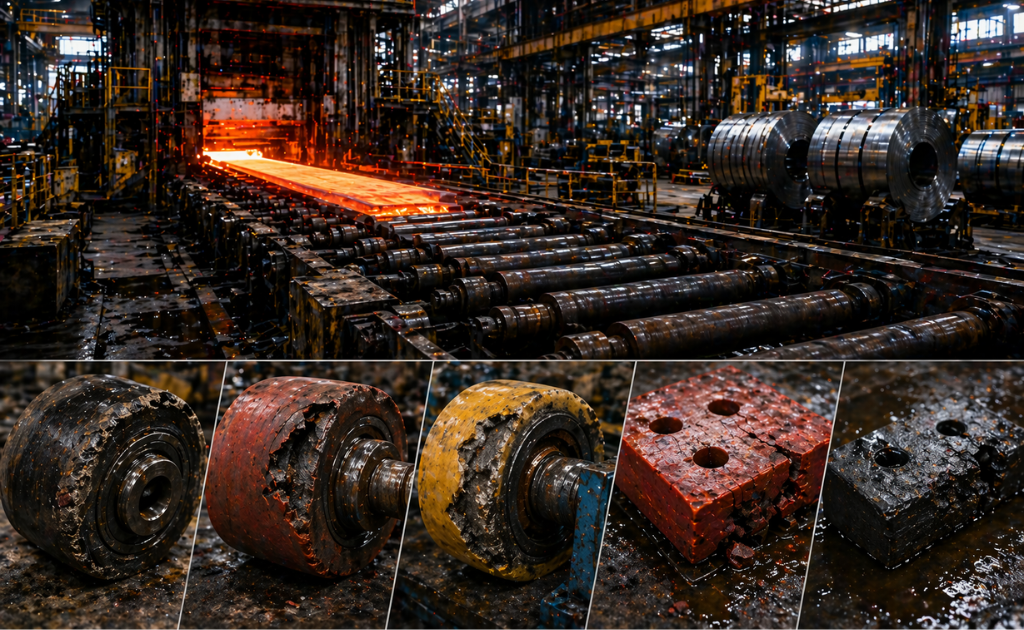
Many steel plants underestimate how much poor-quality rollers, pads, liners, and handling components affect overall productivity. Using low-grade rubber parts, weak bonded rollers, or poorly designed polyurethane products often leads to repeated operational problems that increase maintenance costs and reduce plant efficiency.
This is why investing in high-quality polyurethane components in steel plants is not just a maintenance decision-it is a production and profitability decision.
Frequent Roller Failure and Unexpected Downtime
Low-quality rollers wear out quickly under constant friction, pressure, and heavy coil movement. Cracks, surface peeling, poor bonding, and deformation are common issues that force unexpected shutdowns.
When a guide roller or pinch roller fails in a rolling mill, the entire production line may stop, causing:
- Production delays
- Emergency maintenance costs
- Labor inefficiencies
- Missed delivery schedules
High-performance PU rollers from Mecalsys are designed to withstand these high-load conditions and significantly reduce failure rates.
Surface Damage to Steel Coils
Poor cradle rollers and support pads often create scratches, dents, pressure marks, and surface defects on finished steel coils. This directly affects product quality and customer satisfaction.
In industries where surface finish matters-such as automotive, appliance manufacturing, and coated steel production-even small defects can lead to product rejection and financial loss.
Using precision-engineered cradle rollers and polyurethane pads helps maintain product integrity and protects valuable finished steel.
Higher Maintenance and Replacement Costs
Cheap components may seem cost-effective initially, but frequent replacement quickly increases total operating expenses.
Repeated maintenance leads to:
- Spare inventory costs
- Increased manpower requirements
- Machine stoppages
- Higher annual maintenance budgets
Quality abrasion-resistant polyurethane reduces replacement frequency and delivers better long-term ROI.
Increased Vibration, Noise, and Mechanical Stress
Metal rollers and low-grade elastomer parts often fail to absorb vibration properly. This increases mechanical stress on surrounding machinery and creates excessive operational noise.
Over time, this can damage shafts, bearings, motors, and support systems—resulting in larger repair costs beyond the roller itself.
Polyurethane offers superior shock absorption and vibration dampening, protecting the entire production system.
Chemical and Oil Damage
Steel plants regularly expose components to oils, coolants, solvents, and industrial chemicals. Standard rubber parts often swell, crack, or degrade quickly in these environments.
Poor chemical resistance leads to:
- Seal failure
- Liner breakdown
- Roller surface deterioration
- Frequent contamination issues
This is where chemical-resistant PU liners and custom formulations from Mecalsys provide major operational advantages.
Reduced Equipment Lifespan
When wear parts fail repeatedly, the damage spreads to larger and more expensive machinery. Poor-quality polyurethane can shorten the life of conveyors, rolling mills, coil handling systems, and finishing lines.
Instead of protecting equipment, low-grade components become the reason for premature equipment failure.
This is why choosing properly engineered custom polyurethane components is essential for long-term plant reliability.
The Real Cost of Poor-Quality Components
The biggest mistake many steel plants make is focusing only on purchase price instead of lifecycle cost.
Low-cost components often create:
- More downtime
- More breakdowns
- More product rejection
- More maintenance
- More hidden operational losses
The better investment is high-performance polyurethane solutions that deliver longer life, stable performance, and lower total ownership cost.
That is exactly where Mecalsys helps steel plants achieve measurable improvements in uptime, efficiency, and profitability.
Selection Guide for Steel Plant Applications
Not all polyurethane components in steel plants use the same material grade. Selecting the correct PU formulation is essential for maximum performance and Key Selection Factors are
Shore Hardness
Different applications require different hardness levels.
- Softer grades for cushioning and impact absorption
- Harder grades for rollers and heavy-load applications
Most steel applications range from 70A to 95A.
Temperature Range
Typical operating conditions fall between -20°C and 80°C, but specialized formulations may be required for higher temperatures.
Load and Speed
High-speed rollers and heavy coil loads require precise balancing between elasticity and strength.
Chemical Exposure
Coolants, oils, acids, and solvents affect performance. Selecting the right chemical-resistant PU liners ensures longer service life.
Bonding Method
For heavy-duty operations, steel-backed PU with advanced bonding offers superior strength and reliability.
Mecalsys Process
Mecalsys follows a proven process:
Consultation → Custom Design → Mold Development → Testing → Delivery
This ensures every product matches the plant’s actual operating conditions.
For example, Mecalsys PU rollers in galvanizing lines have helped customers achieve up to 300% longer service life compared to standard alternatives.
That is the true value of properly engineered abrasion-resistant polyurethane steel industry solutions.
Why Choose Mecalsys for Polyurethane Products
With over 10 years of manufacturing expertise, Mecalsys has become a trusted name in custom polyurethane solutions for steel plants, textile units, mining operations, and heavy industries.
Why Industries Prefer Mecalsys
- Custom-built solutions for each application
- ISO-quality manufacturing standards
- Fast turnaround for urgent industrial requirements
- Competitive pricing with long-term cost savings
- Strong technical consultation support
- Expertise in metal + PU hybrid systems
Their specialization in Mecalsys polyurethane solutions ensures that customers receive not just a product, but a complete performance upgrade for their plant.
Whether you need steel mill rollers, cradle rollers, polyurethane pads, or protective wear liners, Mecalsys delivers high-performance solutions built for real industrial demands.
Final words on polyurethane components in steel plants
The value of polyurethane components in steel plants lies in their ability to reduce downtime, improve wear resistance, protect finished steel surfaces, and extend equipment life.
From PU rollers and cradle rollers to pads, liners, and coated mill rollers, polyurethane has become essential for modern steel manufacturing.
For reliable, custom-engineered, and cost-effective solutions, Mecalsys leads the way.
Request a free consultation today at Mecalsys and discover how the right polyurethane solution can transform your steel plant performance.
FAQs on polyurethane components in steel plants
What are the best polyurethane components in steel plants?
The most common and effective components include PU rollers, cradle rollers, polyurethane pads, wear liners, seals, and coated mill rollers. These improve durability and reduce maintenance costs.
How do Mecalsys PU rollers improve steel mill efficiency?
Mecalsys PU rollers offer better wear resistance, longer service life, reduced downtime, and improved coil handling performance compared to standard rubber rollers.
Polyurethane vs rubber for steel plant wear parts?
Polyurethane lasts significantly longer, handles higher loads better, and offers stronger abrasion resistance than rubber, making it the better choice for demanding steel applications.
Does Mecalsys offer custom polyurethane solutions for rolling mills?
Yes. Mecalsys provides fully customized polyurethane products based on load, temperature, hardness, and chemical exposure requirements.
What is the lifespan of Mecalsys cradle rollers?
Depending on usage conditions, Mecalsys cradle rollers often last 3–5 times longer than standard rubber alternatives due to their high-impact absorption and wear resistance.