In abrasive industrial environments, component failure is not just a maintenance issue – it directly impacts productivity, operational efficiency, and downtime costs. Industries such as mining, mineral processing, bulk material handling, construction, slurry transportation, and heavy manufacturing constantly deal with wear-related challenges caused by friction, impact, and aggressive materials.
Choosing the wrong wear component can lead to premature failure, increased replacement frequency, and expensive shutdowns. Understanding how to choose polyurethane parts for abrasive industrial applications is essential for plant engineers, OEM manufacturers, maintenance teams, and procurement professionals who want to improve equipment life and reduce downtime.
This is why polyurethane (PU) has become one of the most preferred materials for abrasive industrial applications. Polyurethane parts offer an excellent balance of abrasion resistance, flexibility, impact strength, load-bearing capability, and service life compared to traditional materials like rubber, steel, or plastics. However, selecting the right polyurethane part is not as simple as choosing the hardest material available.
Abrasion conditions vary significantly depending on moisture, particle size, impact severity, temperature, chemical exposure, and operational load.
This guide explains how to choose polyurethane parts for abrasive industrial applications using a practical engineering-focused approach. Instead of generic product recommendations, this article focuses on wear mechanisms, polyurethane material selection, hardness considerations, environmental conditions, and application-specific requirements that influence long-term performance.
1. Understand the Type of Abrasion in Your Application
The first step in selecting polyurethane parts is understanding how wear occurs in your application. Different abrasion mechanisms require different polyurethane properties. Many premature failures happen because the wear mode was incorrectly identified during specification.
Sliding Abrasion
Sliding abrasion occurs when abrasive material continuously moves across a surface under pressure. This is common in:
- Chute liners
- Hopper liners
- Conveyor skirting
- Scraper blades
- Material transfer points
In sliding abrasion, the polyurethane surface experiences continuous friction and cutting action. The material must provide strong sliding-wear resistance, cut resistance, and hardness balance without becoming brittle.
For these applications, polyurethane formulations with controlled hardness and high tear strength generally perform better than extremely soft or overly rigid compounds.
Impingement or Impact Abrasion
Impingement abrasion occurs when particles strike a surface at high speed or repeated impact angles. Common examples include:
- Slurry pump components
- Hydrocyclone liners
- Sandblast curtains
- Industrial bumpers
- Impact pads
In these environments, impact resilience becomes more important than surface hardness alone. A polyurethane part that is too hard may crack under repeated shock loading. High rebound resilience and energy absorption are critical for extending service life.
Slurry or Wet Abrasion
Wet abrasion combines abrasive wear with moisture, chemicals, and hydrolysis exposure. This is frequently seen in:
- Mining slurry systems
- Mineral processing equipment
- Dredging operations
- Wet screening systems
- Pump liners
In slurry environments, polyurethane selection becomes more complex because the material must resist both abrasion and chemical degradation. Hydrolysis resistance, water resistance, and compatibility with slurry chemistry are extremely important.
Wear Mode and Critical PU Properties
| Wear Mode | Typical Parts | Important PU Property |
| Sliding abrasion | Chute liners, scrapers | Sliding-wear resistance, cut resistance |
| Impingement abrasion | Bumpers, impact pads | Rebound resilience, impact strength |
| Slurry/wet abrasion | Slurry pumps, hydrocyclones | Hydrolysis resistance, chemical compatibility |
Understanding the dominant wear mechanism allows engineers to avoid over-specifying hardness while ignoring more important material properties.
2. Choose the Right Polyurethane Family: Polyether vs Polyester
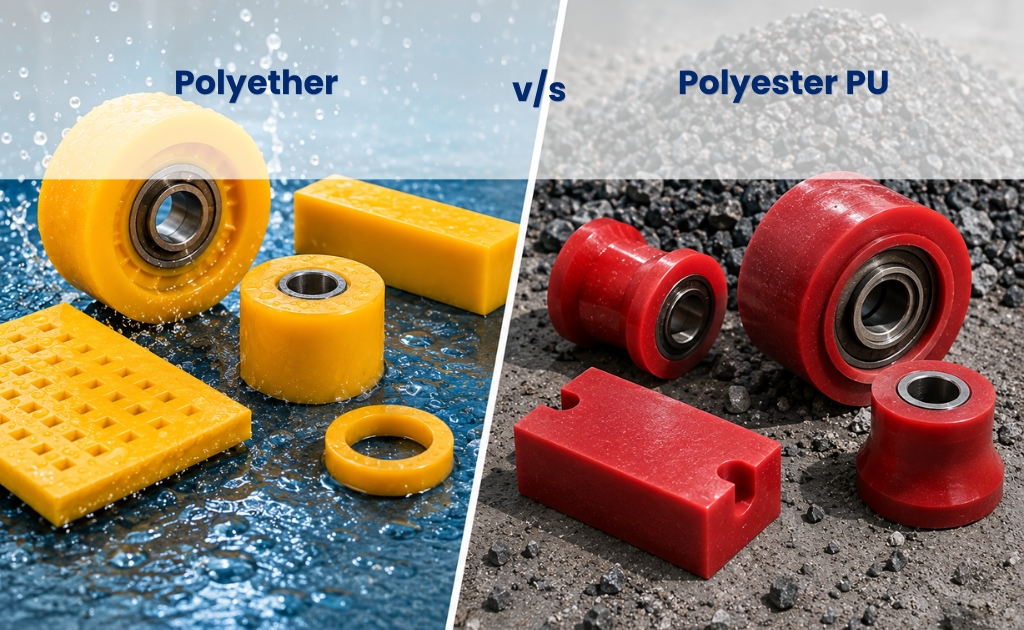
One of the most important decisions in polyurethane selection is choosing between polyether polyurethane and polyester polyurethane. Both materials offer excellent wear resistance, but they behave differently depending on environmental conditions.
Many industrial buyers mistakenly assume all polyurethane grades perform similarly. In reality, selecting the wrong polyurethane family can significantly reduce service life.
When to Choose Polyether Polyurethane
Polyether polyurethane is generally preferred for wet and humid environments because it offers excellent hydrolysis resistance and flexibility.
Polyether PU is commonly used for:
- Slurry pump liners
- Hydrocyclones
- Wet mining systems
- Marine applications
- Water-exposed rollers
- Wet processing equipment
Advantages of polyether polyurethane include:
- Better resistance to water and moisture
- Improved hydrolysis resistance
- Higher flexibility
- Better low-temperature performance
- Strong impact resilience
If your application involves water, slurry, humidity, or repeated washdowns, polyether polyurethane is usually the safer choice.
When to Choose Polyester Polyurethane
Polyester polyurethane is often selected for dry abrasive applications where maximum mechanical strength and sliding wear resistance are required.
Common polyester PU applications include:
- Conveyor scrapers
- Dry chute liners
- Heavy sliding wear systems
- Rollers and wheels
- Industrial skirting systems
Advantages of polyester polyurethane include:
- Higher tensile strength
- Better oil and solvent resistance
- Improved cut resistance
- Excellent dry sliding abrasion resistance
However, polyester polyurethane can degrade faster in wet or hydrolytic conditions if not properly formulated.
Polyether vs Polyester PU Comparison
| Property | Polyether PU | Polyester PU |
| Water resistance | Excellent | Moderate |
| Hydrolysis resistance | Excellent | Lower |
| Oil resistance | Good | Very good |
| Dry abrasion resistance | Very good | Excellent |
| Impact resilience | High | Moderate-high |
| Wet slurry suitability | Excellent | Limited in harsh wet conditions |
Experienced polyurethane manufacturers evaluate the full service environment before recommending a material family. Companies like Mecalsys Intech often customize formulations based on actual operational data rather than offering one-size-fits-all solutions. Also check this research…
3. How Hardness (Durometer) Affects Wear Life
Hardness is one of the most misunderstood factors in polyurethane selection. Many buyers assume higher hardness automatically means longer wear life. In reality, harder polyurethane is not always better.
A polyurethane part that is too hard may crack, chip, or fail under impact loading. A part that is too soft may deform excessively or wear quickly under sliding abrasion.
The ideal hardness depends on the wear mechanism and operating environment.
Typical Hardness Recommendations
Sliding Abrasion Applications
Applications like chute liners, conveyor skirting, and scrapers commonly use polyurethane in the range of:
- 80-95 Shore A
This range balances abrasion resistance with enough flexibility to avoid brittle cracking.
Impact Applications
Impact-heavy environments often benefit from medium-to-high hardness compounds with strong rebound characteristics. Excessively hard compounds can fracture under repeated impact loading.
Wheels and Rollers
Load-bearing wheels and rollers may require higher hardness for dimensional stability and rolling efficiency, especially under heavy loads.
How to Specify Hardness Correctly
Instead of requesting the hardest possible material, engineers should focus on:
- Wear mechanism
- Load conditions
- Impact severity
- Deflection requirements
- Service environment
Hardness should be optimized alongside rebound resilience, tear strength, tensile strength, and compression set properties.
Avoid Over-Specifying Hardness
One common mistake is forcing suppliers to manufacture a specific durometer without testing the actual service conditions. In many cases, slight hardness adjustments dramatically improve performance.
Experienced polyurethane manufacturers often fine-tune hardness after reviewing:
- Failure patterns
- Wear history
- Operating speeds
- Material flow characteristics
- Particle sharpness
Collaborative testing usually produces better long-term results than rigid hardness specifications.
4. Key Service-Environment Factors to Collect Before Specifying PU Parts
One of the best ways to improve polyurethane performance is collecting accurate service data before selecting materials. A detailed operating profile helps manufacturers recommend the correct formulation, hardness, thickness, and bonding configuration.
This step is frequently ignored, which leads to poor material selection and shorter service life.
What Data Should You Gather?
Before requesting polyurethane parts, operations teams should answer the following questions:
Is the Service Wet or Dry?
Wet conditions introduce hydrolysis, moisture exposure, and chemical compatibility concerns. Dry systems focus more heavily on sliding abrasion and cut resistance.
What Type of Abrasive Material Is Involved?
The particle size, sharpness, and hardness significantly affect wear patterns.
Examples include:
- Ore
- Sand
- Gravel
- Coal
- Slag
- Minerals
- Aggregates
Sharp angular particles usually create more aggressive cutting wear than rounded materials.
What Are the Load and Impact Conditions?
Understanding impact severity helps determine whether the material should prioritize:
- Flexibility
- Rebound
- Hardness
- Tear resistance
Is Metal Bonding Required?
Many polyurethane parts are cast onto steel inserts or bonded to metal structures.
Examples include:
- Rollers
- Wheels
- Pipe liners
- Bushings
- Structural wear components
Poor bonding design can lead to delamination and premature pull-out failures.
What Is the Expected Service Life?
The economics of downtime matter just as much as material cost. A slightly more expensive polyurethane formulation may significantly reduce maintenance frequency and shutdown costs.
Simple PU Specification Checklist
Before contacting a polyurethane supplier, collect the following:
- Application type and component name
- Wet or dry operating conditions
- Temperature range
- Abrasive material type and particle size
- Chemical exposure details
- Load and impact severity
- Operating speed
- Existing failure mode
- Expected service life
- Bonding or insert requirements
- Dimensional drawings or samples
- Maintenance and downtime costs
Providing this information improves material selection accuracy and reduces trial-and-error failures.
5. Common Polyurethane Part Types in Abrasive Industrial Applications
Different polyurethane parts require different material strategies depending on operating conditions.
Chute and Hopper Liners
Chute liners experience heavy sliding abrasion from continuous material flow. Important factors include:
- Abrasion pattern
- Thickness selection
- Mounting method
- Material flow angle
- Particle sharpness
Both polyester and polyether polyurethane may be suitable depending on moisture exposure and operating conditions.
Slurry Pump and Hydrocyclone Liners
These applications combine:
- Wet abrasion
- Chemical exposure
- High-velocity impact
Polyether polyurethane is often preferred because of its hydrolysis resistance and resilience under slurry conditions.
Bumpers, Wheels, and Rollers
These components require:
- Impact resistance
- Rebound resilience
- Load-bearing capability
- Compression resistance
Improper hardness selection can lead to flat spotting, cracking, or excessive deformation.
Bushings and Seals
Bushings and seals operate under oscillation, contamination, and pressure.
Critical factors include:
- Heat generation
- Compression set
- Lubrication
- Environmental contamination
Custom formulations are often necessary for demanding industrial systems.
Scrapers and Conveyor Skirting
These parts require strong:
- Cut resistance
- Sliding wear resistance
- Edge durability
- Dimensional stability
Excessively soft compounds may wear quickly, while overly rigid materials may chip or crack.
Common PU Parts and Recommended Material Focus
| Part Type | Primary Wear Type | Recommended PU Focus |
| Chute liners | Sliding abrasion | High wear and cut resistance |
| Slurry pump liners | Wet abrasion + impact | Hydrolysis-resistant polyether |
| Bumpers | Impact abrasion | High rebound resilience |
| Rollers and wheels | Load + rolling wear | Compression and abrasion balance |
| Scrapers | Sliding wear | Tear and cut resistance |
6. Why You Should Not Choose PU Parts by Catalog Alone
Catalog specifications provide useful baseline information, but they rarely capture the complexity of real industrial operating conditions.
Many failures occur because buyers select polyurethane solely based on:
- Hardness
- Tensile strength
- Generic abrasion ratings
- Price comparisons
This approach often ignores critical environmental factors.
Hardness Alone Is Misleading
A 95 Shore A polyurethane may outperform an 85 Shore A material in one application but fail rapidly in another due to impact cracking or poor resilience.
Wrong Material Family Causes Premature Failure
Using polyester polyurethane in aggressive wet environments may accelerate hydrolysis degradation. Similarly, using soft polyether materials in severe dry sliding systems may reduce wear life.
Bonding and Geometry Matter
Even high-quality polyurethane formulations can fail if:
- Bonding systems are weak
- Insert designs are poor
- Wall thickness is incorrect
- Stress concentrations are ignored
Engineering support is just as important as material quality.
How We Help Select the Right Polyurethane Part
An experienced polyurethane supplier should evaluate:
- Wear mechanism
- Service environment
- Existing failure history
- Material flow behavior
- Load and impact conditions
- Bonding requirements
- Maintenance objectives
Instead of providing generic catalog products, the best suppliers use application engineering and testing to improve long-term performance.
7. Practical Steps to Select PU Parts for Abrasive Applications
Selecting polyurethane parts becomes much easier when approached systematically.
Step 1: Identify the Main Failure Mode
Determine whether the dominant issue is:
- Sliding abrasion
- Impact abrasion
- Wet slurry wear
- Chemical attack
- Cut damage
- Compression fatigue
The failure mode drives material selection.
Step 2: Define the Service Environment
Collect data about:
- Moisture exposure
- Temperature
- Chemicals
- Load
- Speed
- Particle characteristics
Environmental factors heavily influence polyurethane performance.
Step 3: Select the PU Family
Use the operating environment to determine whether polyether or polyester polyurethane is more suitable.
- Wet/slurry systems → Polyether PU
- Dry sliding systems → Polyester PU
Step 4: Define Hardness and Configuration
Select appropriate:
- Durometer range
- Thickness
- Reinforcement
- Bonding system
- Metal inserts
- Mounting style
This stage should involve supplier consultation whenever possible.
Step 5: Prototype and Test
Testing small batches before full implementation helps validate:
- Wear life
- Impact performance
- Bond durability
- Material compatibility
Field trials often reveal optimization opportunities that cannot be predicted from laboratory data alone.
Final Thoughts on How to Choose Polyurethane Parts for Abrasive Industrial Applications
Understanding how to choose polyurethane parts for abrasive industrial applications is essential for improving equipment life, reducing downtime, and lowering maintenance costs in demanding industrial environments.
The correct polyurethane component depends on several critical factors, including:
- Wear mechanism
- Environmental exposure
- Hardness requirements
- Bonding design
- Impact conditions
- Abrasive material characteristics
There is no universal polyurethane formulation suitable for every industrial application. Wet slurry systems, dry sliding environments, impact-heavy machinery, and chemical exposure all require different polyurethane engineering strategies.
Engineering-driven manufacturers like Mecalsys Intech help industries develop customized polyurethane rollers, wheels, liners, pads, bushes, seals, pipeline pigs, and molded PU components tailored for high-wear industrial environments. By combining material expertise with application-focused manufacturing, industries can achieve longer service life, improved machine efficiency, and better operational performance.